- Repair vs. Replace Is a Long-Term Ownership Decision
- Rule 1: Do Not Focus Only on What Is Cheapest Today
- Rule 2: Review the Repair History
- Rule 3: Compare the Repair Cost With Replacement in Context
- Rule 4: Consider the Impact on the Tenant
- How to Apply the Four Rules to Common Rental Property Problems
- Keep Better Maintenance Records
- Preventive Maintenance Can Change the Decision
- Do Not Let a Simple Formula Replace Professional Judgment
- Remember Legal and Lease Responsibilities
- Need Help Managing Rental Property Maintenance in Central Indiana?
- Frequently Asked Questions
- Look beyond today's repair bill by comparing the long-term value of repairing versus replacing an item.
- Review an item's age, condition, and repair history together before deciding on the most practical next step.
- Consider how recurring maintenance issues may affect both your property and the resident's overall experience.
- Keep detailed maintenance records so future repair-or-replace decisions are based on facts instead of guesswork.
A tenant calls and says the stove is not working. Do you send someone to repair it, or do you replace it?
The same question comes up with furnaces, air conditioners, water heaters, appliances, and other parts of a rental property. For landlords and real estate investors, the cheapest solution today is not always the most cost-effective decision over the next several years.
A small repair may extend the life of an item for years. Another repair may simply delay an inevitable replacement while creating more service calls, more frustration, and more disruption for the tenant.
So how do you decide?
In the video below, Jason Warner of Indiana Property Management Group explains four practical rules rental property owners can use when deciding whether to repair or replace an item.
The goal is not to create a rigid formula. It is to make a better decision by looking beyond the immediate repair bill.
Want expert guidance on managing your property?
Repair vs. Replace Is a Long-Term Ownership Decision
When something breaks, the natural reaction is often:
What is the cheapest way to solve this problem today?
That is understandable, but it can be too narrow.
A better question is:
What is the most cost-effective decision over the next few years?
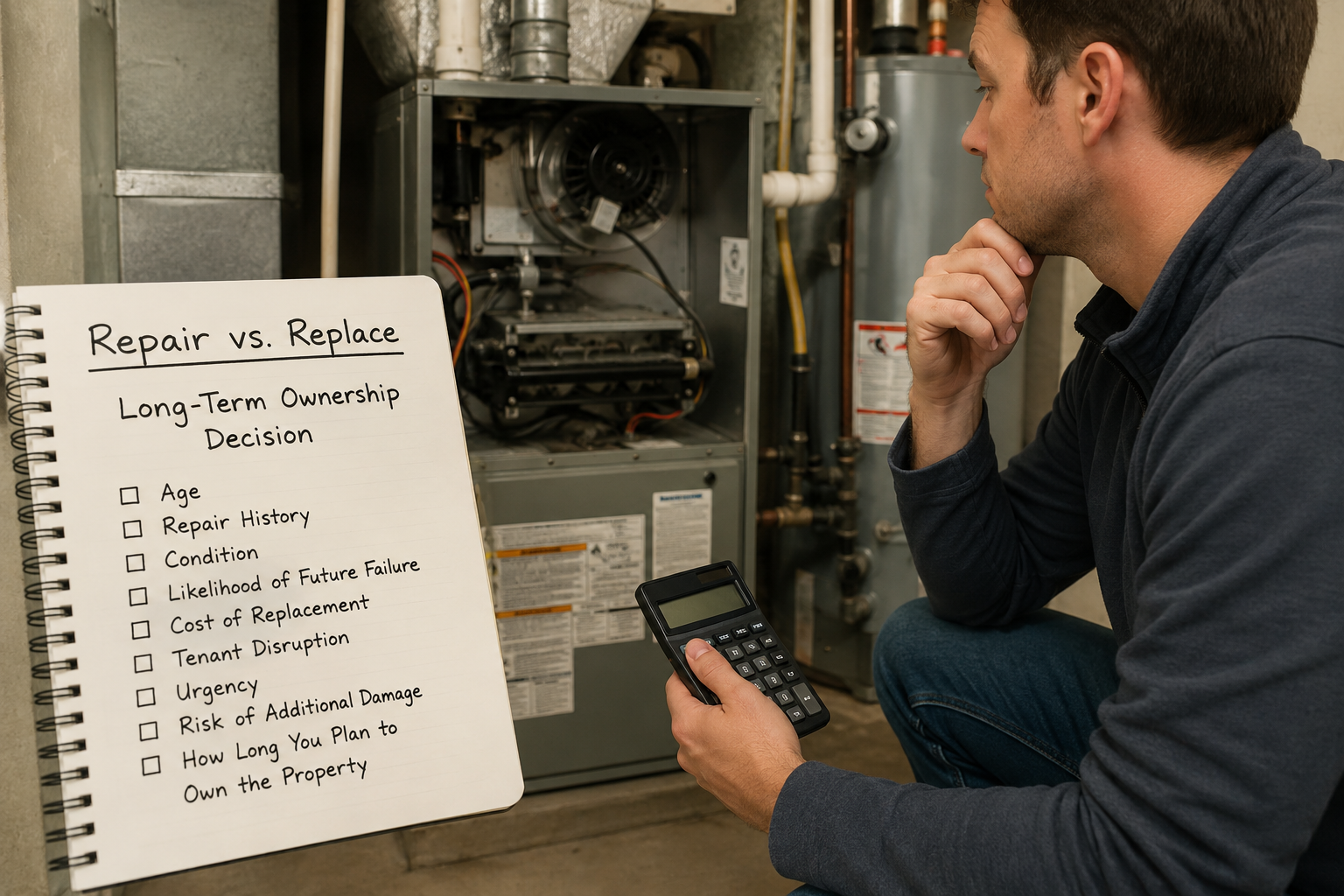
That means considering more than the current quote. Depending on the situation, you may also need to think about:
- The age of the item
- Its repair history
- Its current condition
- The likelihood of another failure
- The cost of replacement
- The disruption to the tenant
- The urgency of the issue
- The risk of additional property damage
- How long you plan to own the property
This same long-term thinking can help owners avoid common Indianapolis landlord mistakes, especially when a delayed maintenance issue becomes a larger problem.
There is no universal answer for every furnace, stove, water heater, or rental home. But the following four rules can make the decision much clearer.
Rule 1: Do Not Focus Only on What Is Cheapest Today
The lowest immediate cost is not automatically the best financial decision.
Imagine that an older appliance stops working. A repair may be less expensive than replacement today, but that does not tell you whether the repair is a good investment.
Before approving the cheapest option, ask:
- How old is the item?
- Is this likely to solve the problem for a meaningful amount of time?
- Are other major components also wearing out?
- Have we already spent money repairing this item?
- Would a replacement provide more predictable performance?
- Could another failure create additional damage or tenant disruption?
A repair makes sense when it restores a reasonably reliable item to service at a sensible cost.
A repair becomes less attractive when you are repeatedly spending money to keep an unreliable item alive.
The key is to think beyond this week’s invoice.
Rule 2: Review the Repair History
One of the most useful pieces of information is the item’s maintenance and repair history.
A single problem does not necessarily justify replacement. But repeated failures can change the decision.
For example, ask:
- Has this item failed before?
- How many service calls has it required?
- Are the same problems returning?
- Are different components beginning to fail?
- How much downtime has the tenant experienced?
- Do we have reliable records of previous repairs?
This is why good maintenance documentation matters.
If a furnace has needed repeated attention, that history should be part of the next decision. The same applies to a water heater, refrigerator, stove, dishwasher, air conditioner, or other supplied equipment.
Do not evaluate the newest repair quote in isolation.
Look at the full history.
Want help organizing the repair history of your property and more?
Rule 3: Compare the Repair Cost With Replacement in Context
The third rule is to compare the repair with the cost and practical value of replacement.

But there is an important point:
The same repair can make sense for a newer item and make far less sense for an older one.
Age alone should not make the decision, but age changes the context.
Consider:
- The current repair cost
- The realistic replacement cost
- The age of the item
- Its overall condition
- Previous repair spending
- Whether parts are readily available
- Whether a qualified professional expects the repair to provide a durable solution
For HVAC systems, ENERGY STAR’s guidance on when to replace heating and cooling equipment can be a useful reference when age, repeat repairs, and performance concerns start stacking up.
There is no single repair-to-replacement percentage that works for every rental property and every piece of equipment.
A landlord should be cautious about rigid rules such as:
“Always replace when the repair reaches a certain percentage of the new price.”
That type of shortcut can ignore condition, repair history, urgency, tenant impact, and the expected value of the repair.
Instead, compare the options in context.
Rule 4: Consider the Impact on the Tenant
This is one of the most overlooked parts of the decision.
A repair may appear cheaper on paper while creating a poor experience for the person living in the home.
Consider an unreliable furnace that keeps failing.
Each failure may mean:
- Another maintenance request
- Another appointment
- Another vendor visit
- More time waiting for service
- More disruption inside the home
- Possible time away from work
- Growing frustration with the property
Eventually, the tenant may stop viewing the problem as a broken furnace.
They may view it as a poorly managed home.
That matters because today’s maintenance decision can affect tomorrow’s tenant relationship.
When evaluating repair versus replacement, ask:
If this item fails again, what will that experience be like for the tenant?
A slightly cheaper decision today may become much more expensive if recurring problems contribute to dissatisfaction, nonrenewal, vacancy, or turnover.
That does not mean every broken item should immediately be replaced. It means tenant impact belongs in the decision.
How to Apply the Four Rules to Common Rental Property Problems
The framework becomes easier to use when you apply it to real situations.
Still have questions about the rules? We can help
HVAC Systems
For a furnace or air-conditioning system, consider:
- System age
- Repair frequency
- Nature of the current failure
- Overall condition
- Professional diagnosis
- Expected reliability after repair
- Tenant comfort and urgency
- Replacement options
A newer system with an isolated problem may be a strong repair candidate.
An older system with repeated failures deserves a broader conversation before another repair is automatically approved.
Preventive care also matters. ENERGY STAR publishes an HVAC maintenance checklist that owners can use as a reference when planning routine system care with qualified professionals.
Water Heaters
For a water heater, ask:
- How old is the unit?
- What exactly failed?
- Is the problem isolated?
- Has the unit required previous service?
- Is there evidence of a leak or other condition that could threaten the property?
- What does a qualified professional recommend?
The potential consequences of another failure should be considered alongside the immediate repair cost.
Stoves, Refrigerators, and Other Appliances
Appliances can be frustrating because a service call and repair may represent a meaningful portion of the cost of another unit.
Before deciding, look at:
- Appliance age
- Repair history
- Current diagnosis
- Availability of parts
- Likelihood of future problems
- Replacement options
- Tenant disruption
The right answer may differ between a relatively new appliance with one failed component and an older appliance that has already required repeated service.
The important point is not to make the decision based on the repair invoice alone.
Roofs, Plumbing, and Other Property Components
The same four-rule framework can help with other maintenance decisions, although larger building systems may require additional professional evaluation.
Ask:
- What solves the problem most cost-effectively over time?
- What is the repair history?
- How does the repair compare with replacement in the context of age and condition?
- What happens to the tenant and property if the problem returns?
For major systems, safety concerns, active leaks, electrical issues, structural concerns, and other urgent problems should be evaluated promptly by appropriately qualified professionals.
Keep Better Maintenance Records
Good decisions require good information.
At minimum, consider tracking:
- Date of each service call
- Reported problem
- Vendor diagnosis
- Work completed
- Cost
- Parts replaced
- Age of the item
- Warranty information
- Whether the same problem has happened before
Without records, owners can accidentally approve repeated repairs without realizing how much money has already gone into the same item.
Maintenance history turns a guess into a more informed decision.
Owners can also review our owner FAQs for more information about how Indiana Property Management Group handles common management questions.
Preventive Maintenance Can Change the Decision
Repair-versus-replace decisions should not begin only after something completely fails.
Regular maintenance may help identify problems earlier and give owners more time to:
- Gather information
- Compare options
- Plan for replacement
- Avoid rushed decisions
- Coordinate work with tenants
A planned decision is usually easier to evaluate than an emergency decision made while a tenant is waiting for heat, hot water, or a working appliance.
That is another reason to treat maintenance as an ongoing ownership system rather than a series of unrelated emergencies.
Do Not Let a Simple Formula Replace Professional Judgment
Landlords sometimes want one universal rule:
- Replace after a certain age
- Repair below a certain dollar amount
- Replace when a quote reaches a certain percentage of new equipment
Simple formulas can be helpful as a starting point, but they should not replace judgment.
A better decision considers:
- Age
- Condition
- Repair history
- Diagnosis
- Reliability
- Replacement cost
- Urgency
- Tenant impact
- Property risk
When the stakes are high, get a qualified professional diagnosis before committing to a major repair or replacement.
Do you need help arranging a professional diagnosis? We can help
Remember Legal and Lease Responsibilities
A financial repair-versus-replace analysis does not override an owner’s legal responsibilities.
Before delaying work, review Indiana landlord-tenant law and the terms of the lease, and seek qualified legal advice when necessary.
Responsibilities can depend on the type of issue, the circumstances, the rental agreement, applicable codes, and other facts. Urgent health or safety concerns should not be treated like ordinary discretionary upgrades.
Need Help Managing Rental Property Maintenance in Central Indiana?
The best maintenance decisions are rarely based on one invoice.
They come from understanding the property, knowing the repair history, working with reliable professionals, communicating with tenants, and thinking about long-term ownership costs.
For rental property owners still deciding whether to handle everything themselves, professional property management services can provide support with maintenance coordination, tenant communication, and day-to-day operations.
Indiana Property Management Group works with rental property owners in Indianapolis and surrounding Central Indiana communities.
Whether you own one rental home or a growing portfolio, our team can help you manage maintenance issues and make more informed decisions about your property.
Contact Indiana Property Management Group to discuss your rental property and management needs.
Curious about how we can optimize your property?
Frequently Asked Questions
Should Landlords Create a Repair-or-Replace Budget for Rental Properties?
Setting aside funds for both routine repairs and future replacements can make maintenance decisions more strategic. Instead of reacting only when something fails, owners can plan for the expected lifespan of major systems such as HVAC equipment, water heaters, roofing, and appliances.
A maintenance reserve also makes it easier to compare repair costs against replacement without feeling pressured to choose the lowest immediate expense. Reviewing your property's maintenance history and updating your budget annually can help you prepare for larger capital expenses while supporting long-term ownership goals.
How Often Should Major Rental Property Systems Be Professionally Inspected?
Inspection frequency depends on the type of equipment, manufacturer recommendations, and the property's age and condition. Many owners schedule annual HVAC servicing before peak heating and cooling seasons, while other systems are typically evaluated during routine maintenance visits or when performance begins to decline.
Preventive inspections can identify worn components before they become larger repairs, giving owners more time to compare options and budget for replacements. Working with qualified service professionals and maintaining consistent inspection records helps support more informed maintenance decisions over time.
When Does It Make Sense to Replace an Appliance Instead of Repairing It?
There is no universal rule that applies to every appliance. A newer refrigerator, dishwasher, or stove with a single failed component may be worth repairing, while an older appliance with repeated service calls and limited parts availability may justify replacement.
Owners should compare the repair cost alongside the appliance's age, maintenance history, overall condition, and expected reliability after the repair. Looking at the complete picture rather than using a fixed dollar threshold often leads to better long-term decisions.
Can Professional Property Management Help With Repair-Versus-Replace Decisions?
Many property management companies coordinate maintenance by obtaining vendor recommendations, tracking repair history, and helping owners evaluate available options.
Indiana Property Management Group provides maintenance coordination as part of its property management services for rental owners in Indianapolis and surrounding Central Indiana communities, allowing owners to make informed decisions based on the property's history and professional assessments rather than a single repair estimate.
Do you need expert support when making informed decisions?
Are There Legal Considerations Before Delaying a Repair in an Indiana Rental Property?
Yes. Financial considerations should not override a landlord's legal obligations under Indiana law or the terms of the lease agreement. Some maintenance issues, particularly those involving health, safety, or habitability, may require prompt attention depending on the circumstances.
Because every situation is different, owners should review their lease, understand applicable state and local requirements, and consult a qualified attorney when legal questions arise. Addressing maintenance concerns promptly can also help reduce the likelihood of larger property issues developing over time.
What Maintenance Records Should Rental Property Owners Keep?
Maintaining organized records makes future repair decisions much easier. Owners should keep the date of each service visit, vendor invoices, inspection reports, repair descriptions, replacement parts used, warranty information, and notes about recurring issues.
Recording the installation date of major systems and appliances can also provide valuable context when comparing repair and replacement options years later. Good documentation supports budgeting, simplifies maintenance planning, and provides a clearer history when evaluating the long-term performance of each property component.
This article is general educational information and is not legal advice.
